Front Yard Landscaping in Glendale CA With California-Friendly Plants
A front yard in Glendale has to do more than look presentable from the curb. It has to tolerate heat, respect water restrictions, suit the architecture, and stay manageable through long dry stretches. That is a different assignment than simply replacing one lawn with another, or filling a planter with whatever happens to be blooming at the nursery that week.
Good front yard landscaping in Glendale CA starts with the realities of the place. Glendale Water & Power remains in Phase III of its Mandatory Water Conservation Ordinance, which limits outdoor watering to two days a week, Tuesday and Saturday, for no more than 10 minutes per watering station. That one rule changes the design conversation immediately. A landscape that depends on frequent shallow watering will struggle. A landscape built around California-friendly plants, efficient irrigation, mulch, and sensible hardscape can settle in and look intentional rather than thirsty.
The best Glendale front yards I have seen do not try to imitate the green, water-heavy landscapes of cooler regions. They use texture, structure, shade, stone, decomposed granite, low-water shrubs, and seasonal color in a way that feels local. They also respect the house. A Spanish Colonial Revival home asks for a different plant rhythm than a Tudor Revival, a Craftsman, or a French-inspired property. Glendale has a rich architectural fabric, including neighborhoods such as Rossmoyne with hundreds of historic homes, so the front yard should feel like it belongs to the building, not like it was copied from a generic landscape design catalog.
Why Glendale front yards need a different approach
The old default front yard in much of Southern California was a broad lawn, clipped hedges, foundation shrubs, and a sprinkler system set to run often enough to keep everything green. In Glendale, that model has become expensive, fragile, and increasingly out of step with local water policy. The City actively encourages drought-tolerant and California-friendly landscaping, and it has invested in public examples such as a downtown drought-tolerant demonstration garden and a water-wise garden site with more than 200 examples of California native landscapes.
The numbers behind the shift are not abstract. Glendale has stated that native plants can survive drought with about 20 gallons of water per month, compared with up to 4,000 gallons per month for a green lawn in summer. Every site is different, and every plant needs care while establishing, but the comparison captures why turf replacement has become such a practical conversation for homeowners.
There is also the value of the property to consider. Glendale is not a low-stakes housing market. The median value of owner-occupied housing units is over $1 million, and only a portion of housing units are owner-occupied. In a market like that, curb appeal matters. A front yard that looks neglected can make a strong house feel tired. A well-designed, water efficient landscape can make the same house feel cared for, current, and better connected to its setting.
That does not mean every front yard should become a gravel field with a few scattered succulents. In fact, the most successful drought tolerant landscaping usually has more life and nuance than that. It combines plants with different heights, leaf shapes, bloom cycles, and densities. It uses hardscaping to guide movement and reduce irrigation demand, but it still gives the eye softness and seasonal change.
California-friendly does not mean one style
The phrase “California-friendly plants” covers a broad range. Some are California native plants. Others are well-adapted, low-water plants from climates that behave similarly. What matters in a front yard is not only water use, but how the plants perform in the exact conditions of the site.
A hot parkway strip near pavement behaves differently from a shaded entry path. A south-facing slope dries out faster than a protected courtyard. A front yard that gets reflected heat from a stucco wall may need tougher plants than a yard softened by mature trees. Experienced landscape design begins by reading those small differences.
Native plants have a natural advantage when used well. Many are built for dry summers, seasonal change, and leaner soils. They can also support a regional look that feels authentic rather than imported. The trade-off is that some native plants look their best when given room and proper pruning, not when sheared into tight shapes. Others have a seasonal dormant period that homeowners must understand before they assume the plant is failing. A good landscaper Glendale CA homeowners can rely on should explain those habits before planting, not after the first summer.
California-friendly planting can be formal or relaxed. Around a Spanish Colonial Revival home, the design might use structured masses, clean edges, courtyard-like paving, and silvery or deep green foliage. Around a Craftsman, softer layers and natural textures may feel more appropriate. For Tudor Revival or French-inspired homes, the planting can still conserve water while using more tailored forms, repeated shrubs, and defined pathways to complement the architecture.
The City’s own design guidance asks whether landscape design complements the building and conserves water. That is the right standard. A front yard should not treat water efficiency and curb appeal as competing goals. It should achieve both.
The lawn question: replace it, reduce it, or keep a small piece
Many Glendale homeowners begin with one question: should we remove the front lawn? Often, the answer is yes, or at least mostly yes. A full front lawn is difficult to justify when outdoor watering is limited and summer water demand can be high. The City’s Turf Replacement Program supports homeowners who replace turf with drought-tolerant or native plants, landscape contractors drip or efficient irrigation, and rainwater capture. The rebate is $3 per square foot, which can make a meaningful difference on larger front yard projects.
There is an important detail that homeowners sometimes miss. Synthetic grass is not an approved conversion option under that program. Artificial turf and synthetic grass may still be discussed in certain residential landscaping projects, especially where a homeowner wants a consistently green play or pet area, but it should not be confused with Glendale’s turf replacement rebate pathway. If the goal is to qualify for that program, the design needs to follow the approved direction: drought-tolerant or native planting, efficient irrigation, and rainwater capture.
Keeping a small section of living lawn can be reasonable in some cases. A modest turf panel near an entry, for example, may provide visual relief or serve a specific use. But it should be treated as a deliberate design choice, not the leftover piece that survived a partial renovation. If sod installation is part of the plan, the irrigation system must be set up to support it efficiently, and the homeowner has to accept the maintenance and water implications.
For many front yards, a better strategy is to replace the lawn with planted zones, a walkway, perhaps a seating area, and enough open negative space to keep the design from feeling crowded. Decomposed granite, pavers, gravel mulch, boulders, and low-water groundcovers can all play a role, but they need proportion. Too much stone can create glare and heat. Too many small plants can look busy. Too much empty gravel can look unfinished.
Designing for Glendale’s watering rules
A beautiful planting plan fails if the irrigation does not match it. Under Glendale’s Phase III rules, outdoor watering is limited to Tuesday and Saturday for no more than 10 minutes per watering station. That makes efficient irrigation systems more than a nice upgrade. They are central to the success of the landscape.
Drip irrigation is often the right tool for California-friendly front yard landscaping because it delivers water near the root zone with less waste than overspray. It also reduces runoff ridgelineoutdoorliving.com landscapers Glendale CA onto sidewalks and driveways when designed properly. But drip is not magic. It needs correct zoning, pressure regulation, filters, proper emitter spacing, and maintenance. A tangled retrofit with mismatched parts can perform worse than an older system that at least worked consistently.
Sprinkler installation still has a place for certain living turf areas, but overspray and runoff are common problems in older front yards. If spray heads are watering the sidewalk, driveway, stucco wall, or street, the system is wasting water and probably harming the landscape by uneven coverage. A landscape renovation should include an irrigation audit at minimum. On many projects, it makes sense to rebuild the front yard irrigation from the valve forward, especially when converting lawn to planted beds.
Mulch matters as much as people say it does. Glendale’s guidance emphasizes mulch, leak repair, drip irrigation, watering early or late in the day, and California-friendly plants. In practice, mulch helps moderate soil temperature and slows evaporation. Organic mulch also gives planted areas a finished look while the garden fills in. Gravel mulch can work in some modern or Mediterranean-style designs, but it should be chosen with heat and glare in mind.
The first year after planting is the delicate period. Even drought-tolerant plants need consistent water while they establish roots. Homeowners sometimes hear “low water” and assume “no water,” which leads to stressed plants and expensive replacements. A professional landscape contractor Glendale homeowners hire should set expectations clearly: establishment is one phase, long-term maintenance is another.
The front yard as architecture, not decoration
The strongest front yard landscaping does not begin at the nursery. It begins at the street, with a clear look at the house. Where is the front door? How does a visitor approach it? What architectural lines deserve emphasis? Which views should be softened? Where does the sun hit hardest? Where does water naturally move?
In Glendale, these questions matter because many homes have character. Spanish Colonial Revival homes often respond well to simple massing, warm paving, ornamental grasses, agaves, sages, and carefully placed accent plants. Craftsman homes can handle more layered planting, informal paths, and materials that feel grounded rather than glossy. Tudor Revival and French-inspired homes may call for a more composed front garden, with low-water plants arranged in a way that gives structure without forcing a high-water cottage garden look.
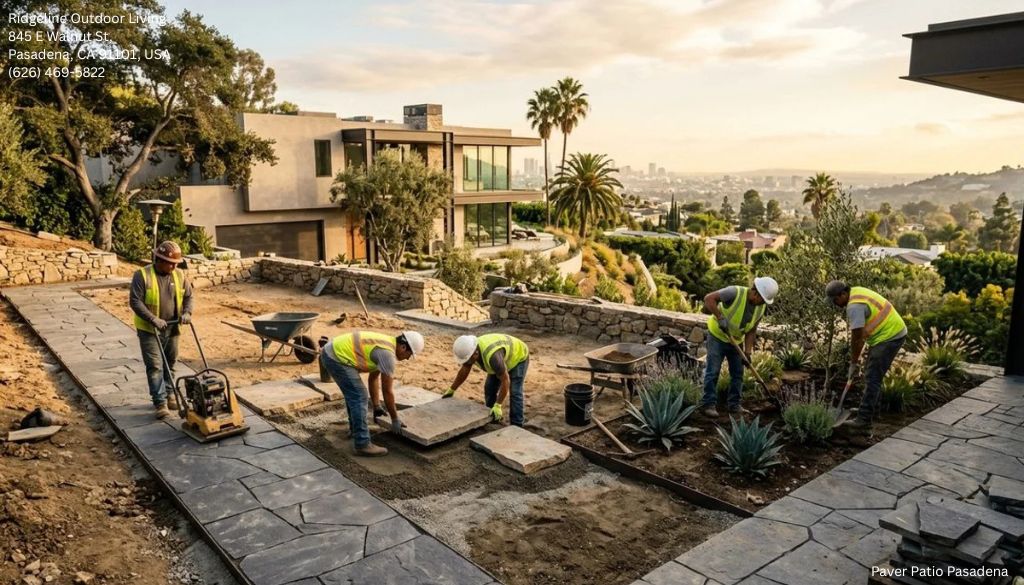
Hardscaping helps make that connection. A front walkway that is too narrow, cracked, or misaligned can make the entire yard feel awkward. A paver patio near the front of the house, if the site allows it, can create a small outdoor sitting area that feels welcoming rather than exposed. Patio installation in the front yard is not right for every property, but when it is tucked near an entry, screened with planting, or connected to a porch, it can turn unused lawn into real living space.
Retaining walls are another common design element where function and appearance meet. They may be needed to manage grade changes, define planting terraces, or hold a slope. A retaining wall in the front yard should look integrated with the house and planting, not like an afterthought. The material choice, cap detail, height, and drainage all matter. Poorly built walls can stain, lean, trap water, or dominate the yard. A capable hardscape contractor should discuss structure and drainage as carefully as appearance.
Hardscape is also where budgets can move quickly. Pavers, walls, steps, and custom masonry often cost more than plants, but they also form the bones of the landscape. If the budget cannot cover everything at once, it is usually better to build the permanent hardscape correctly and phase the planting than to spend heavily on plants while leaving failing concrete or drainage problems untouched.
A practical framework for plant selection
Plant selection should be both artistic and disciplined. A front yard with one of everything may look exciting on planting day, then chaotic a year later. Repetition creates calm. Contrast creates interest. The balance between the two is where good custom landscape design shows.
For Glendale, the plant palette should favor drought tolerant landscaping, low maintenance landscaping, and water efficient landscaping without sacrificing character. Native plants can form the backbone, especially when the homeowner wants a landscape tied closely to the region. California-friendly non-natives may be used where they solve a specific design need, such as structure, screening, or long bloom, as long as they fit the water strategy.
A useful front yard palette often includes a small number of anchor plants, several mid-level shrubs or perennials, a ground plane, and a few accents. The anchors give the yard structure through the year. The mid-level planting carries texture and bloom. The ground plane reduces bare soil and helps connect the composition. Accent plants should be used sparingly. When every plant is an accent, nothing feels special.
Here is a concise way to think about the roles plants need to fill in a Glendale front yard:
- Structure near the house, where evergreen or long-lasting forms visually connect the planting to the architecture.
- Texture along paths and edges, where movement and leaf contrast can soften hardscape.
- Seasonal color in measured drifts, rather than scattered single plants.
- Ground coverage to reduce exposed soil and help the landscape feel complete.
- Heat-tolerant accents in the most visible areas, used with restraint.
That kind of discipline also helps maintenance. A gardener can understand repeated plant masses more easily than a yard full of isolated specimens with different pruning needs. The result tends to look better after two or three years, which is the real test of landscape installation.
Parkway landscaping and permits
The parkway, the strip between the sidewalk and curb where it exists, can make or break curb appeal. It is also one of the harshest places to grow plants. It gets reflected heat, foot traffic, car-door conflicts, and sometimes limited soil volume. In Glendale, it comes with another important issue: permitting.
The City requires a permit from Public Works for installing any living or non-living plant materials over 12 inches high in parkways. Parkway landscaping is governed by Glendale Municipal Code Chapter 12.48. That means homeowners should not treat the parkway as a free-for-all planting zone. Before adding taller plants, boulders, built features, or dense shrubs, the design needs to account for City requirements.
From a design standpoint, parkway plants should stay durable, low, and legible. They should not block visibility, crowd passengers stepping out of cars, or create thorny hazards along the curb. The best parkway designs are often simpler than the main yard. They echo the planting palette without trying to carry the whole composition.
A landscape contractor familiar with local requirements can help avoid rework. Nothing sours a landscape renovation faster than installing attractive parkway improvements, then discovering they conflict with municipal rules.
Irrigation, rainwater, and the hidden work below the surface
Homeowners naturally focus on what they can see: plants, pavers, walls, lighting, mulch. Professionals spend a lot of time worrying about what happens below the surface. Soil preparation, irrigation layout, drainage, root space, and grading decide whether the front yard matures gracefully or declines after the first hot season.
Glendale’s Turf Replacement Program includes rainwater capture as part of the approved conversion approach. That does not mean every front yard needs a complicated system. Sometimes it means shaping the site so rainwater can soak into planted areas instead of running straight to the gutter. Sometimes it means directing roof runoff thoughtfully. The right answer depends on the lot, slope, existing drainage, and architecture.
Grading is especially important when replacing lawn. Lawns often hide subtle drainage problems because they create a continuous green surface. Once the turf is removed and replaced with planting areas, paths, gravel, and pavers, water movement becomes more visible. If runoff crosses a walkway or collects near the foundation, the design needs adjustment before installation is complete.
Irrigation zoning deserves the same attention. A newly planted native shrub, an established tree, a small turf area, and a container near the entry should not all be on the same watering schedule. Even under a two-day watering limit, the system can be designed to apply water more intelligently by grouping plants with similar needs. That is the difference between merely having irrigation and having irrigation that supports the landscape.
Leak repair is not glamorous, but it is one of the most useful water-saving steps. A broken lateral line, a cracked fitting, or a valve that does not close completely can waste water quietly for weeks. During a front yard renovation, old irrigation should be pressure-tested and inspected rather than simply capped in random places and forgotten.
Hardscape choices that reduce water without creating heat
Hardscaping often becomes part of water efficient landscaping because it reduces planted square footage and creates usable space. But more hardscape is not automatically better. In a hot, dry climate, the wrong hardscape can make the front yard feel harsh.
Paver patio areas, entry walks, stepping paths, low walls, and seating edges should be sized to the way people actually use the home. A front path should allow two people to walk comfortably when space permits. Steps should feel safe and proportional. A small sitting patio should have enough room for furniture without forcing chairs into planting beds. These practical dimensions matter more than decorative complexity.
Material color affects comfort. Very light materials can glare. Very dark materials can absorb heat. Mid-tone pavers, natural stone, decomposed granite, and concrete finishes can all work when selected to complement the house. The goal is not to match every surface, but to create a restrained material palette.
For front yard landscaping, I usually prefer hardscape that guides movement and creates small moments rather than paving everything open. A path that widens near the entry feels generous. A low wall that doubles as a seat can make a yard more welcoming. A band of pavers through planting can break up a large space without requiring water. These details help the design feel intentional, not simply reduced.
Retaining walls deserve special care because landscapers Glendale CA they are permanent and visible. Even a modest wall changes the way a front yard reads from the street. Wall height, alignment, material, and planting at the base or top should be resolved during design, not improvised in the field. If structural needs are present, the wall should be built accordingly by qualified professionals.
Maintenance: low maintenance is designed, not wished into existence
Low maintenance landscaping is a reasonable goal, but it has to be designed from the start. Plants must be given enough room to reach mature size. Irrigation must be accessible. Mulch must be replenished. Edges must be clear enough that maintenance crews understand what to trim and what to leave natural.
One common mistake is planting too densely because the yard looks sparse on installation day. A new California-friendly landscape may look young for the first season. That is normal. Overplanting can create crowding, disease pressure, and constant pruning later. A better approach is to use mulch, boulders, temporary spacing, and strong layout to make the young landscape look intentional while it grows.
Pruning style matters. Many drought-tolerant and native plants do not respond well to being sheared into balls or boxes. They often look better with selective pruning that respects their natural form. If the maintenance crew treats every shrub the same way, the design loses its character. Homeowners should discuss maintenance expectations with the landscaper before installation, especially if the property has a regular gardener.
Glendale’s gas-powered leaf blower prohibition is another maintenance consideration. Electric equipment is now part of the local landscape maintenance reality, and the City offers rebates for electric leaf blowers purchased in Glendale or elsewhere. For homeowners, this reinforces the value of designing landscapes that do not depend on aggressive weekly cleanup. Mulch that stays in place, sensible plant spacing, and durable groundcovers can reduce mess and maintenance friction.
When artificial turf fits, and when it does not
Artificial turf and synthetic grass come up in many Glendale landscaping conversations because homeowners want green appearance without lawn watering. It can be useful in specific residential landscaping situations, particularly where a small, durable surface is needed and living turf would be impractical. It may also appear in backyard landscaping, pet areas, or narrow spaces where plant health would be difficult.
For front yard landscaping tied to Glendale’s turf replacement rebate, however, synthetic turf is not an approved conversion option. That distinction should be clear from the beginning. If a homeowner’s priority is rebate eligibility, the design needs Landscape community guide to move toward drought-tolerant or native plants, efficient irrigation, and rainwater capture.
There are also design trade-offs. Artificial turf provides a consistent green plane, but it does not offer the seasonal movement, habitat value, or cooling effect of living planting. In a front yard, especially one connected to a character home, large synthetic areas can look flat if they are not carefully integrated. It may solve one maintenance issue while creating an aesthetic compromise.
For many Glendale front yards, a planted landscape with strong structure provides a better long-term result. It may take patience during establishment, but it tends to gain character as it matures.
What a thoughtful front yard renovation process looks like
A successful landscape renovation does not need to be complicated, but it should be orderly. The worst projects tend to start with demolition before anyone has resolved drainage, irrigation, plant selection, or hardscape layout. That creates field decisions under pressure, which usually cost more and look less cohesive.
A reliable process for front yard landscaping in Glendale CA usually includes these steps:
- Evaluate the site, including sun exposure, slopes, existing irrigation, drainage, parkway conditions, and architectural style.
- Develop a landscape design that balances curb appeal, water efficiency, plant maturity, and hardscape needs.
- Confirm City-related requirements, including parkway permit issues where applicable and rebate direction if turf replacement is planned.
- Install hardscape, grading, irrigation systems, soil preparation, plants, and mulch in the correct sequence.
- Adjust watering and maintenance during establishment so the landscape can transition from new installation to long-term performance.
That process applies whether the project is a modest lawn conversion or a full custom landscape design with pavers, retaining walls, lighting, and layered planting. The scale changes, but the logic does not.
Front yard and backyard priorities are not the same
Many homeowners plan front yard landscaping and backyard landscaping at the same time, which can be efficient. Still, the two spaces have different jobs. The front yard is public-facing. It shapes curb appeal, frames the architecture, and manages the daily experience of arriving home. The backyard often carries more private functions: outdoor living spaces, dining, play, pets, shade, and entertainment.
Because of that, the front yard should usually be simpler and more composed. It does not need every feature. A front paver patio can be excellent if the house and site support it, but a full outdoor living room may feel exposed. Retaining walls may be necessary in front, but they should not overpower the entry. Planting can be expressive, but it should not block the view of the home.
Backyards can sometimes absorb more experimentation. Front yards reward restraint. In Glendale, where many homes have strong architectural identities, that restraint often produces the most valuable curb appeal.
Choosing the right professional for Glendale conditions
A good landscaper Glendale CA homeowners hire should bring more than planting labor. The project may involve landscape design, landscape installation, irrigation systems, hardscaping, sprinkler installation, patio installation, retaining walls, and knowledge of drought tolerant landscaping. If the front yard includes walls, pavers, drainage changes, or significant irrigation work, the homeowner may need a landscape contractor or hardscape contractor with the right experience for the scope.
Local judgment matters. Glendale’s watering rules, parkway requirements, climate, rebate structure, and architectural context all affect the work. A contractor who treats every city the same may miss details that determine whether the finished yard performs well.
During early conversations, homeowners should listen for specificity. Does the contractor talk about hydrozones, mulch depth, plant maturity, runoff, and maintenance? Do they distinguish between native plants and general low-water plants? Do they understand that synthetic grass is not part of the City’s approved turf replacement conversion? Do they ask about the house style and how the landscape should complement it? Those answers reveal whether the project is being approached as a durable landscape or a quick cosmetic change.
A front yard that belongs in Glendale
California-friendly front yard landscaping is not a downgrade from a lawn. Done well, it is more interesting, more resilient, and better suited to Glendale’s climate and water realities. It can frame a historic home with dignity, give a newer home stronger curb appeal, and reduce the constant struggle to keep thirsty grass alive through summer.
The right design uses water where it matters and avoids wasting it where it does not. It treats plants as living architecture. It uses hardscaping to create access, structure, and usable space. It respects parkway rules. It plans irrigation carefully. It accepts that low maintenance does not mean no maintenance, and that young landscapes need time to mature.
For Glendale homeowners, the opportunity is practical and aesthetic at the same time. A front yard can conserve water, qualify for meaningful turf replacement incentives when designed properly, and still feel warm, refined, and personal. The most successful projects do not announce themselves as drought tolerant. They simply look right for the house, right for the street, and right for Southern California.